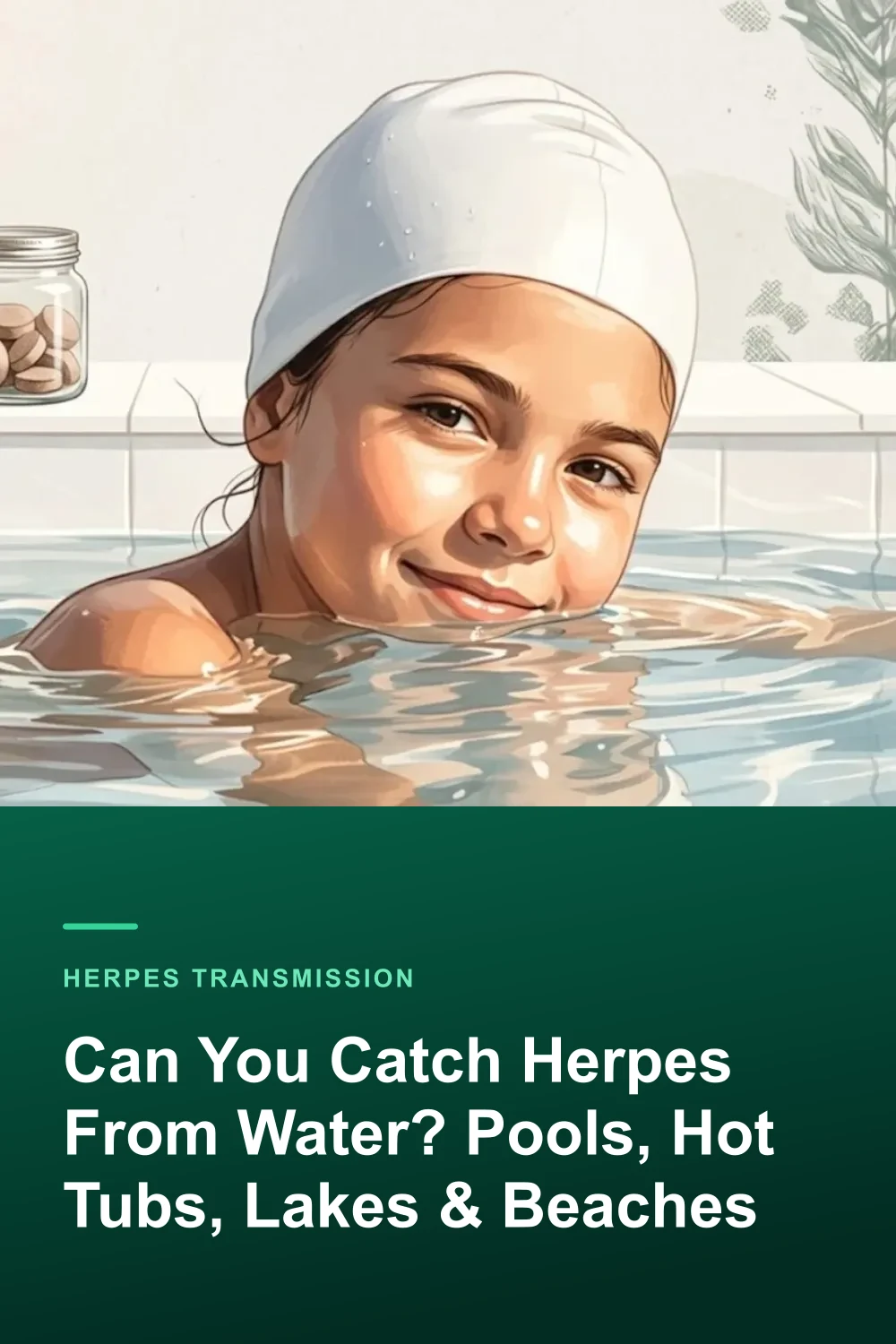
One of the most common questions people ask about herpes transmission is whether the virus can spread through water. Whether you're heading to a public pool, soaking in a hot tub, swimming at the beach, or sharing a bathtub, it's natural to wonder if water can carry herpes simplex virus (HSV) from one person to another.
The short answer: HSV-1 and HSV-2 are extremely fragile outside the human body, and waterborne transmission is considered essentially impossible in real-world conditions. The virus needs direct skin-to-skin or mucosal contact to spread effectively. Water — especially chlorinated, salted, or moving water — rapidly inactivates the virus.
However, that doesn't mean every water-related scenario is risk-free. Shared towels, intimate contact in or near water, and certain hygiene practices can still transmit herpes. This guide breaks down each water environment so you know exactly what's safe and what to watch for.
Simplix Viral Defense
Cold Sore & HSV Support

Simplix Viral Defense
Cold Sore & HSV Support
Synergistic formula combining L-Lysine, shiitake mushroom, and marine bioactives for comprehensive immune support.
SHOP NOW & SAVE 15%How the Herpes Virus Behaves Outside the Body
To understand water transmission, it helps to know how HSV survives outside human tissue. The herpes virus is an enveloped virus, meaning it has a fragile lipid outer membrane. This envelope is essential for the virus to infect new cells — and it's also easily destroyed by heat, soap, drying, sunlight, and disinfectants like chlorine.
Survival Time on Wet vs. Dry Surfaces
Laboratory studies have shown that HSV can survive briefly on moist surfaces — typically minutes to a few hours under ideal conditions — but is rapidly inactivated by exposure to water dilution, temperature changes, and chemical disinfectants. On dry surfaces, the virus dies within seconds to minutes. The dilution effect of large water bodies further reduces any theoretical viral load to undetectable, non-infectious levels.Why Water Makes Transmission So Unlikely
Three factors combine to make water transmission virtually impossible: (1) dilution — even if infected fluid entered the water, it would be diluted billions of times over, (2) disinfection — chlorine, salt, and UV light all inactivate enveloped viruses quickly, and (3) contact requirements — HSV needs sustained contact with mucous membranes or broken skin to establish infection, which moving water disrupts.
Can You Get Herpes From a Swimming Pool?
No, you cannot realistically catch herpes from swimming pool water. Public and residential pools are treated with chlorine (or bromine), which destroys the lipid envelope of HSV within seconds. The Centers for Disease Control and Prevention (CDC) has consistently stated that herpes is not transmitted through swimming pools.
What About Poorly-Maintained Pools?
Even in pools with suboptimal chlorination, the combination of water dilution and the herpes virus's inherent fragility means transmission risk remains negligible. You're far more likely to catch chlorine-resistant pathogens like Cryptosporidium or norovirus from a poorly-maintained pool than herpes.Real Pool Risks (Not Water-Related)
The actual risks at a pool come from non-water contact: sharing towels, lip balm, drinking glasses, or kissing someone with an active oral cold sore. Direct skin contact between an active genital herpes lesion and another person's mucous membrane — for example, during intimate contact in the pool or in a changing room — could theoretically transmit the virus, but the water itself is not the vehicle. For more on herpes at shared fitness spaces, see our guide on herpes risks at the gym.Can You Catch Herpes From a Hot Tub or Jacuzzi?
Hot tubs are another common concern, partly because they involve closer body contact and warmer water. The good news: HSV is even more fragile in hot water than in cool water. Heat above 37°C (98.6°F) — which most hot tubs maintain — accelerates viral envelope breakdown.
Chlorine and Bromine in Hot Tubs
Hot tubs typically use bromine or chlorine as disinfectants. Bromine is particularly effective at higher temperatures, providing reliable inactivation of enveloped viruses including HSV. Properly maintained hot tubs (with sanitizer levels between 3-5 ppm for bromine or 1-3 ppm for chlorine) pose essentially zero risk of waterborne herpes transmission.The Real Hot Tub Risk: Skin-to-Skin Contact
What does pose a genuine risk in hot tubs is direct skin contact with someone who has an active herpes lesion. Because hot tubs encourage close physical proximity and often sexual activity, the risk shifts from water transmission to standard sexual or skin-to-skin transmission. If you or a partner has an active outbreak, avoid intimate contact in the hot tub — but blame the contact, not the water.Hot Tub Folliculitis vs. Herpes
One important note: hot tubs can transmit a bacterial infection called "hot tub folliculitis" (caused by Pseudomonas aeruginosa) that produces small, red, sometimes painful bumps. These can occasionally be mistaken for herpes lesions but are bacterial in origin and unrelated to HSV.Can You Get Herpes From a Lake, River, or Pond?
Natural freshwater environments — lakes, rivers, ponds — present even lower theoretical herpes transmission risk than pools, despite the absence of chlorine. The combination of massive water dilution, UV exposure from sunlight, microbial competition, and temperature variation makes HSV survival in natural water virtually nil.
UV Light: Nature's Disinfectant
Sunlight contains UV radiation that effectively inactivates many viruses, including HSV. In open bodies of water exposed to sunlight, any theoretical viral particles would be destroyed within minutes. This is why outdoor swimming in lakes and rivers presents no realistic herpes risk from the water itself.What to Watch for in Natural Water
While herpes isn't a concern, natural water bodies do carry other potential health risks: bacterial contamination (E. coli, Leptospira), parasitic infections (Schistosoma in some regions), and amoebic infections (Naegleria fowleri in warm freshwater). These are unrelated to HSV but worth being aware of when swimming in untreated water.Can You Catch Herpes at the Beach or in the Ocean?
Saltwater is naturally hostile to most viruses. The high salt concentration in ocean water creates an osmotic environment that damages viral envelopes, while UV exposure from open sun adds additional inactivation. Catching herpes from ocean water is not a realistic concern.
Beach-Specific Risks (Not From Water)
The actual herpes risks at the beach come from the beach environment, not the water:- Sun exposure: UV light is a known trigger for cold sore outbreaks in people already infected with HSV-1. Always use SPF 30+ lip balm. See our article on unusual cold sore triggers for more on UV and environmental risks.
- Shared items: Sunscreen applied with the same tube to multiple people, shared drinks, shared towels, or shared lip balm can transmit HSV if someone has an active oral lesion.
- Direct contact: Kissing or sexual activity with an infected person can transmit the virus regardless of the beach setting.
- Sand abrasion: Minor skin abrasions from sand combined with skin-to-skin contact with infected areas could theoretically increase transmission risk in intimate situations.
Can You Get Herpes From a Shared Bath or Bathtub?
A shared bathtub presents slightly different considerations because there's no disinfection and the water volume is small. However, HSV is still rapidly inactivated by soap, warm water, and dilution. The classic concern — "Can I catch herpes from sharing bathwater with someone who has it?" — is essentially a non-issue when soap is used.
Sharing Bathwater Sequentially
If two people use the same bathwater one after the other (without changing it), the theoretical risk remains extremely low. The virus would not survive in the soapy water long enough to cause infection on intact skin. Mucous membranes and broken skin remain the only realistic transmission routes.Bathing Together: A Different Story
When two people share a bath simultaneously, the risk is not from the water but from direct body contact. If one person has an active herpes lesion (especially genital herpes), prolonged skin-to-skin contact in water — including unintentional brushing of intimate areas — could potentially transmit the virus through direct contact, though the water dilution still significantly reduces this risk compared to dry sexual contact.Hygiene Recommendation
If you're concerned, the simple solution is to shower after sharing a bath. Soap and clean water will eliminate any residual viral particles. Avoid sharing washcloths, loofahs, or razors regardless of herpes status — these can transmit various pathogens.Can You Catch Herpes From a Toilet Seat or Water Fountain?
These are persistent myths worth addressing directly. You cannot catch herpes from a toilet seat, water fountain, faucet, or any other inanimate fixture. The virus simply does not survive long enough on dry or wet surfaces to be transmitted through casual contact.
Why Toilet Seat Transmission Doesn't Happen
For HSV to transmit via a toilet seat, the virus would need to: (1) survive on the cool, dry plastic surface (which it generally cannot for more than minutes), (2) be present in sufficient quantity, (3) come into contact with broken skin or mucous membrane, and (4) avoid being washed away by soap and water. The combination of these requirements makes toilet seat transmission essentially impossible.Drinking Fountains and Faucets
The same logic applies to public water fountains. Even if a person with active oral herpes used a fountain, the virus would be washed away by the next flow of water, diluted by saliva contact zones, and unable to survive long enough to infect another user.When IS Water Involvement a Concern?
Although water itself doesn't transmit herpes, there are scenarios where water settings can indirectly increase risk. For the full picture of what actually triggers herpes reactivation, see our guide on why herpes flares up.
Shared Personal Items in Water Settings
- Towels: A damp towel used by someone with an active oral or genital herpes lesion can briefly harbor the virus. Sharing immediately after use carries a small risk.
- Razors: Never share razors. Microscopic skin breaks combined with virus transfer make this a genuine transmission route.
- Lip balm and chapstick: Direct application to lips makes these high-risk for HSV-1 transmission.
- Drinking glasses and water bottles: Sharing these with someone with an active cold sore can transmit HSV-1.
Sexual Activity in Water
Having sex in a pool, hot tub, or shower with someone who has active herpes lesions doesn't change the fundamental transmission dynamics — it's still skin-to-skin contact that transmits the virus, not the water. Some people incorrectly assume water provides protection; it does not. Physical friction and heat during sexual activity are their own distinct triggers — read our article on sweat, heat and friction as herpes triggers for the full explanation.Open Wounds and Cuts
If you have a fresh cut or significant open wound and bathe with someone with an active genital herpes outbreak, there is a theoretical (though still small) risk of viral entry through the wound. Avoid shared bathing during active outbreaks, especially with broken skin.Can You Catch Herpes From Water? FAQs
Can you get herpes from a swimming pool?
No. Chlorine and the dilution effect of pool water inactivate HSV within seconds. There has never been a documented case of herpes transmission via swimming pool water.
Can you catch herpes from a hot tub?
Herpes cannot be transmitted through hot tub water. Heat, chlorine, and bromine all destroy the viral envelope rapidly. The only real risk in a hot tub is direct skin-to-skin contact with someone who has an active lesion.
Can you get herpes from sharing a bath with someone who has it?
Sharing bathwater itself poses minimal risk because soap and water dilution inactivate the virus. The actual risk comes from prolonged direct skin contact with active lesions during the shared bath, not from the water.
Can you catch herpes from a toilet seat?
No. Herpes simplex virus does not survive long enough on toilet seats or other hard surfaces to cause transmission. This is one of the most persistent and inaccurate myths about herpes.
Can saltwater or ocean water spread herpes?
No. The high salt concentration, sunlight UV exposure, and massive dilution of ocean water make waterborne herpes transmission essentially impossible at the beach.
What about catching herpes from a water bottle or drinking fountain?
Direct sharing of a water bottle with someone who has an active cold sore can transmit HSV-1 because their saliva contacts the bottle opening. Public drinking fountains pose no realistic risk because water flow washes away any viral particles.
If herpes can't spread through water, why do so many people worry about it?
The myth persists partly because herpes carries social stigma, and partly because people don't always understand viral biology. The truth is that HSV is fragile, requires direct contact for transmission, and is destroyed by common disinfectants — making water settings far safer than many fear.
Can children catch herpes from swimming with someone who has cold sores?
Not from the water itself. The risk for children comes from shared towels, sippy cups, kissing, or sharing food — not from being in the pool together. Standard hygiene practices fully address these concerns.

Image: Bravado Labs Advanced Lysine Immune Boost
Bravado Labs Advanced Lysine Immune Boost
Why we love it:
- Verified Customer Favorite
- High Quality Ingredients
As an affiliate, we earn from qualifying purchases.