The standard of care for herpes simplex virus has relied on the same class of drugs—nucleoside analogs like acyclovir and valacyclovir—for decades.
They work by blocking viral DNA synthesis, and they do it well.
But they do not cure the infection, and in immunocompromised patients, drug-resistant HSV strains are a growing clinical concern.
This gap has pushed researchers toward a fundamentally different class of molecules: antimicrobial peptides (AMPs).
If you have been searching for information on peptides for HSV-1, peptides for HSV-2, or more broadly what peptides are good for herpes, you are looking at a field that sits squarely on the frontier of virology.
The findings are genuinely exciting—and also almost entirely confined to the laboratory.
Here is a detailed breakdown of the current science.
Simplix Viral Defense
Cold Sore & HSV Support

Simplix Viral Defense
Cold Sore & HSV Support
Synergistic formula combining L-Lysine, shiitake mushroom, and marine bioactives for comprehensive immune support.
SHOP NOW & SAVE 15%How Peptides Attack the Herpes Virus
To understand why peptides are a promising avenue against herpes, it helps to know what they are targeting.
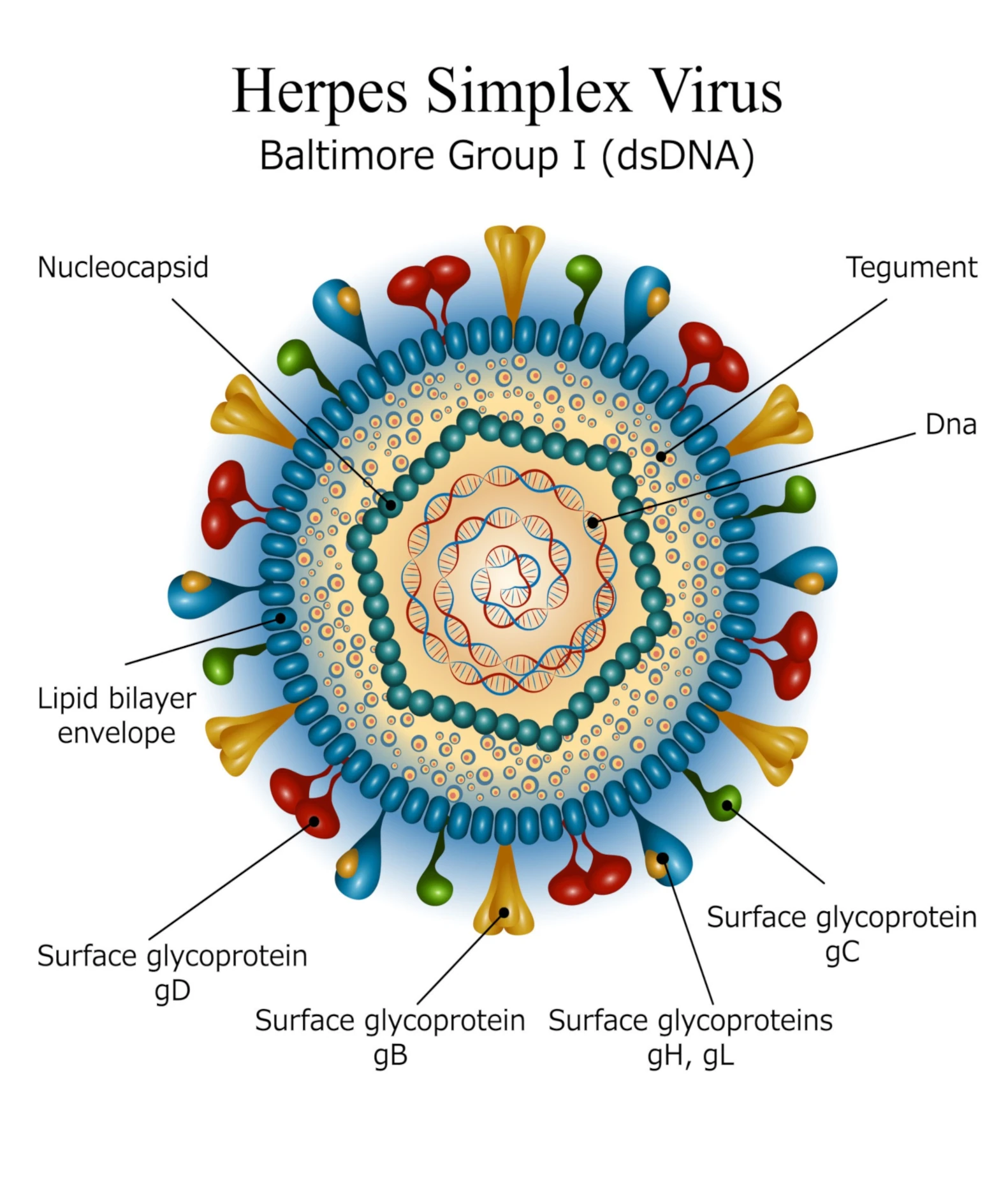
Herpes simplex virus is an enveloped virus: it is wrapped in a lipid bilayer membrane studded with surface glycoproteins (gB, gC, gD, gH, and gL).
The virus uses these glycoproteins to dock with, fuse to, and enter human cells.
Without a functional envelope, the virus cannot infect anything.
Most peptides tested against herpes work through one of two mechanisms:
- Envelope disruption: The peptide physically destabilizes the lipid membrane, destroying the virus before it can reach a cell.
This is direct, irreversible, and does not require the virus to have entered a host.
- Glycoprotein blocking: The peptide binds to one or more surface glycoproteins, acting as a molecular roadblock that prevents the virus from attaching to or fusing with host cells.
These are often called "decoy" or "entry-inhibitor" peptides.
Synthetic Histidine Peptides for Herpes
One of the most studied—and most counterintuitive—categories is synthetic histidine peptides for herpes.
Studies going back several decades have demonstrated that synthetic poly-L-histidine peptides, particularly those with chain lengths between 24 and 75 amino acid residues, can directly and irreversibly inactivate both HSV-1 and HSV-2 within minutes of contact in laboratory settings.
The mechanism is electrostatic: the imidazole side chains of histidine residues interact with negatively charged components on the viral surface, destabilizing the envelope.
What makes these peptides particularly interesting—and also particularly tricky to develop clinically—is that the effect is strongly pH-dependent.
They perform best in mildly acidic environments (pH 5.0 to 6.0) and lose much of their activity at the neutral or slightly alkaline pH of most human tissues.
This pH sensitivity makes synthetic histidine peptides theoretically well-suited for targeted topical applications in naturally acidic environments, but the stability challenge for systemic or broader topical use has not yet been solved.
No histidine peptide-based antiviral has reached human clinical trials.
Cathelicidins: What the Body Already Makes
Cathelicidins are a family of antimicrobial peptides produced naturally as part of the innate immune response in mammals, including humans. They represent the body's first-line peptide defense, and several members of this family have demonstrated potent antiviral activity against herpes simplex virus in laboratory research.
Human LL-37
The primary human cathelicidin is called LL-37. In vitro studies have shown it can disrupt the HSV viral envelope directly, reducing viral infectivity significantly. Cells lining the skin and mucous membranes produce LL-37 during inflammation, which may partly explain why some individuals with robust innate immune responses experience less frequent or less severe outbreaks. However, LL-37 is not available as a therapeutic and is rapidly degraded by the body's own enzymes before it could reach a target site in meaningful concentrations.Animal-Derived Cathelicidins: Hedgehog and Elephant Peptides
Some of the most striking recent findings have come from studying cathelicidins isolated from other species. Research published in 2025 and early 2026 identified highly potent anti-HSV peptides derived from European hedgehogs (CathEE-2a) and Asian elephants (EM-1) — peptides that do not just inhibit viral replication but also actively boost the host's innate immune response by upregulating interferon signaling pathways, giving them a dual mechanism that natural human peptides lack. Alpaca-derived "nanobodies"—small, stable antibody fragments—have also been engineered to trap the HSV fusion machinery in a pre-fusion state, preventing the virus from completing its entry process. These are technically antibody fragments rather than classical peptides, but they represent the same logic: small molecules that block the envelope machinery before infection can occur.
Peptides for HSV-1 and Cold Sores
HSV-1 is primarily associated with oral infections and is the predominant cause of cold sores (herpes labialis).
When researchers evaluate peptides for cold sores, the clinical goal is typically a topical microbicide—something applied at the first sign of tingling that can neutralize virus at the skin surface before a blister fully forms.
In that context, some of the most impressive in vitro data involves synergistic combinations rather than peptides in isolation.
Studies testing specific lipid-ether compounds combined with the peptide D2A21 have shown complete inactivation of HSV-1 in under ten minutes, with the combination attacking the viral envelope through multiple points simultaneously.
Neither compound alone achieved the same result at the same concentration.
This suggests that future topical formulations for cold sores may work best as fixed-dose combinations rather than single peptide treatments.
The appeal for a cold sore application is obvious: the site is accessible, topical delivery avoids the stability and degradation problems that affect systemic peptide therapies, and the pH of the lip and perioral skin is closer to the range where many peptides perform well.
Peptides for HSV-2 and Genital Herpes
Developing effective peptides for HSV-2 and genital herpes presents a harder set of biological problems.
The vaginal and genital environment fluctuates considerably in pH and contains high concentrations of proteolytic enzymes that break down natural proteins rapidly.
A peptide that performs well in a buffered lab solution may be completely destroyed within minutes of being applied to mucosal tissue.
The primary engineering response to this has been the development of peptoids—synthetic mimics of peptides where the side chains are attached to the nitrogen backbone rather than the carbon backbone.
This seemingly small structural change makes peptoids highly resistant to enzymatic degradation while allowing researchers to tune the molecule's antiviral activity to match that of the natural peptide it is based on.
Peptoids retain the membrane-disrupting or receptor-blocking properties of their parent molecules but survive long enough in a biological environment to actually work.
Several research groups are also investigating "decoy" peptides derived from the HSV-2 glycoproteins themselves—short sequences that mimic the part of the viral surface protein that binds to the human cell receptor, saturating the receptor and leaving the virus nothing to attach to.
These have shown promise in cell culture models but have not yet been tested in animals at scale.
The Clinical Reality: What Peptides Are Available for Herpes Right Now
If you are looking for peptides that treat herpes in a form you can actually obtain, the honest answer is that none exist as FDA-approved medications.
The jump from impressive in vitro results to a safe, stable, manufacturable human therapeutic is one of the largest hurdles in pharmaceutical development, and peptide-based antivirals face an unusually concentrated version of that challenge:
- Stability: Natural peptides are degraded by enzymes in the blood, digestive tract, and at mucosal surfaces.
Engineering around this adds cost and complexity.
- Manufacturing: Synthesizing peptides at clinical scale is expensive, far more so than producing small-molecule drugs like acyclovir.
- Immune reactions: Peptides—especially those derived from non-human species—can trigger unintended immune responses.
Extensive safety testing is required before any human trial.
- Delivery: Getting enough of a peptide to the site where the virus is active, in high enough concentration, for long enough to be effective, is a formulation challenge that most candidates have not yet solved.
They are inexpensive, well-tolerated, and have decades of safety data behind them.
Peptide research is not close to replacing them—but the volume and quality of recent findings suggest that the next generation of herpes treatments, perhaps arriving in the early 2030s, may well include a peptide-based component.
Frequently Asked Questions: Peptides and Herpes
What peptides are good for herpes?
In laboratory research, the most studied antiviral peptides against herpes include poly-L-histidine peptides, the human cathelicidin LL-37, animal-derived cathelicidins like CathEE-2a (hedgehog) and EM-1 (elephant), and synthetic peptoids engineered to resist enzymatic degradation. None are currently available as approved treatments.
Do synthetic histidine peptides work against herpes?
In cell culture studies, synthetic poly-L-histidine peptides have shown the ability to irreversibly inactivate both HSV-1 and HSV-2. However, the effect is highly pH-dependent (working best at pH 5.0–6.0) and has only been demonstrated in vitro. No histidine peptide has reached human clinical trials for herpes.
Are there peptides specifically for cold sores (HSV-1)?
Yes, several peptides have been tested against HSV-1 in topical formulations in laboratory settings. Combinations like D2A21 with lipid-ethers have shown rapid and complete inactivation of the virus in under ten minutes in vitro. These findings make topical peptide formulations a plausible future product for cold sores, but none are commercially available yet.
Why are peptides harder to develop for genital herpes than cold sores?
The genital and vaginal environment is enzymatically hostile to natural peptides, breaking them down before they can act. It also fluctuates in pH in ways that reduce the efficacy of pH-sensitive molecules. Researchers are addressing this by developing peptoids—synthetic peptide mimics that are structurally resistant to enzymatic degradation while retaining antiviral activity.
Can peptides cure herpes?
No peptide currently in research is designed to eliminate the latent virus from nerve tissue, which is where HSV hides between outbreaks. Current peptide research focuses on neutralizing active virus or preventing new infections, not on removing established latency. A cure for herpes would require a different type of intervention.
Should I take peptide supplements to treat herpes?
Commercial "peptide supplements" sold online are not the same as the antimicrobial peptides studied in antiviral research. Most oral peptide supplements are broken down in the digestive tract before reaching the bloodstream in active form. There is no supplement currently on the market with evidence that it reduces herpes outbreaks through a peptide mechanism. For managing outbreaks, consult a physician about established antiviral medications.

Image: Bravado Labs Advanced Lysine Immune Boost
Bravado Labs Advanced Lysine Immune Boost
Why we love it:
- Verified Customer Favorite
- High Quality Ingredients
As an affiliate, we earn from qualifying purchases.